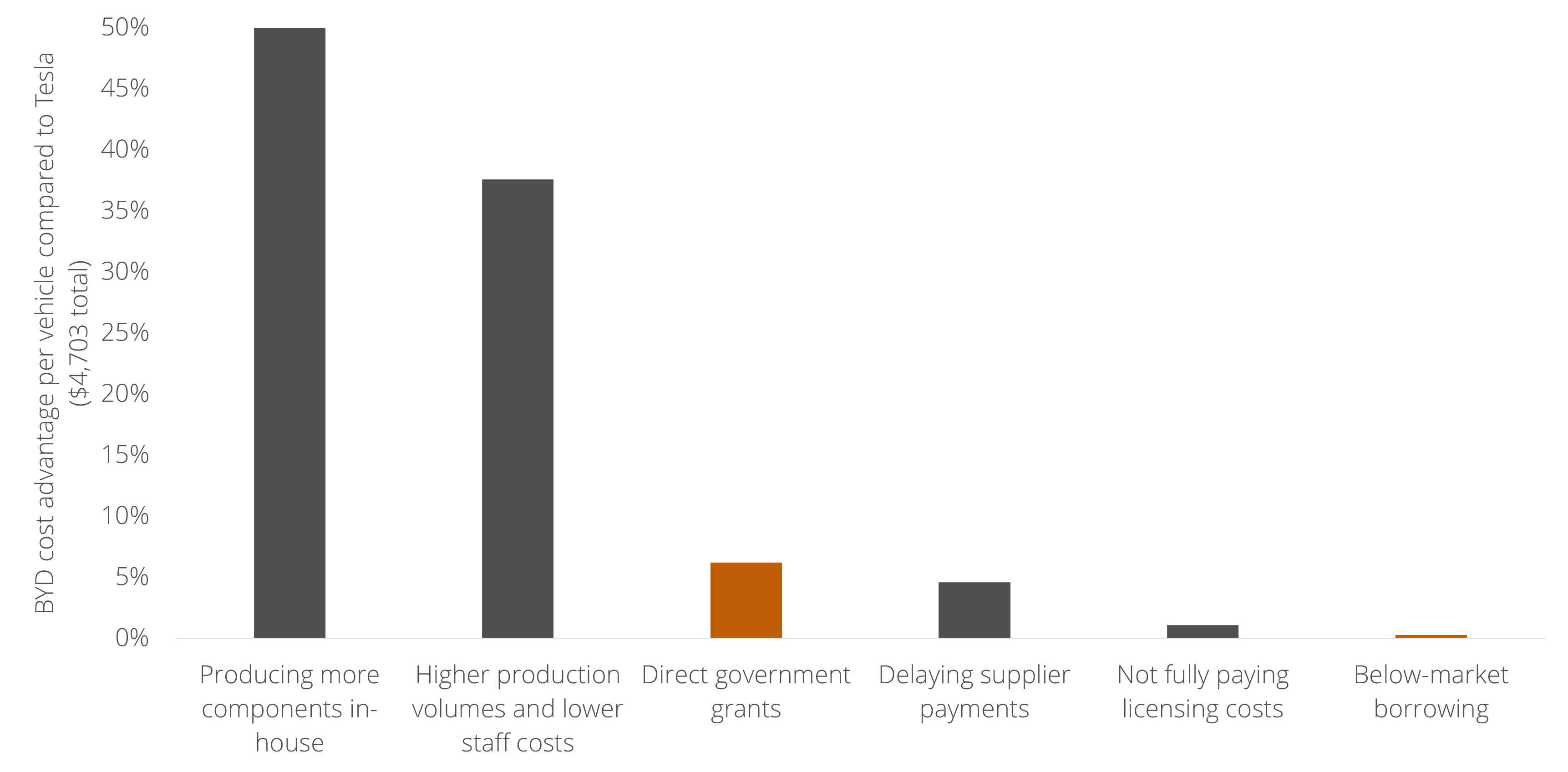
Last week, a new OECD report on industrial subsidies was picked up across western media, highlighting the finding that Chinese companies receive 3 to 8 times more government support than their western counterparts. However, a careful reading of the OECD report shows this figure is misleading – and that framing China's rise as mainly enabled by government subsidies will lead to the wrong response.
First, the OECD shows that higher subsidies for Chinese companies are entirely dependent on below-market borrowing – in other words, relatively low interest rates on loans from Chinese banks to Chinese companies. When it comes to direct grants and income-tax concessions, western governments subsidize their companies at comparable levels as China. This matters because China's below-market borrowing is, as experts like Michael Pettis have shown, a structural feature of its political-economic system: in China, capital is channeled to companies through state banks at below-market rates to keep the economy dependent on investment-led growth, effectively paid for by Chinese households, who receive artificially low returns on their savings. This is not a targeted subsidy program, but something far more deeply embedded in how the Chinese Communist Party chooses to develop the country - and therefore not something that will be overcome through responses like import tariffs or western subsidies.
Second, and this is what deserves closer attention, the OECD data shows significant variation between industries. The automotive industry is worth examining, because it is the sector that both the US and the EU have targeted with import tariffs, explicitly justified by claims of unfair Chinese subsidies. Research by the Rhodium Group shows that only 5% of the cost advantage of Chinese cars is based on government subsidies. The remaining 95% reflects genuine competitive strengths: the vertical integration of Chinese manufacturers – who produce their own batteries and other components or source them domestically, unlike western firms that rely on complex global supply chains – and higher levels of investment in research and development, supported by lower labor costs and a longer planning horizon.
The implication is that framing the rise of Chinese companies as primarily a subsidy story leads to the wrong response. For instance, since the EU raised import tariffs on Chinese cars in October 2024, the market share of Chinese cars in Europe has continued to grow, while some European manufacturers that produce their cars in China lost market share, as they found themselves penalized by their own governments' tariffs. Rather than focusing on penalizing China for its industrial model, western governments would be wise to address their own competitiveness – and to maintain access to world-class Chinese products in the meantime.