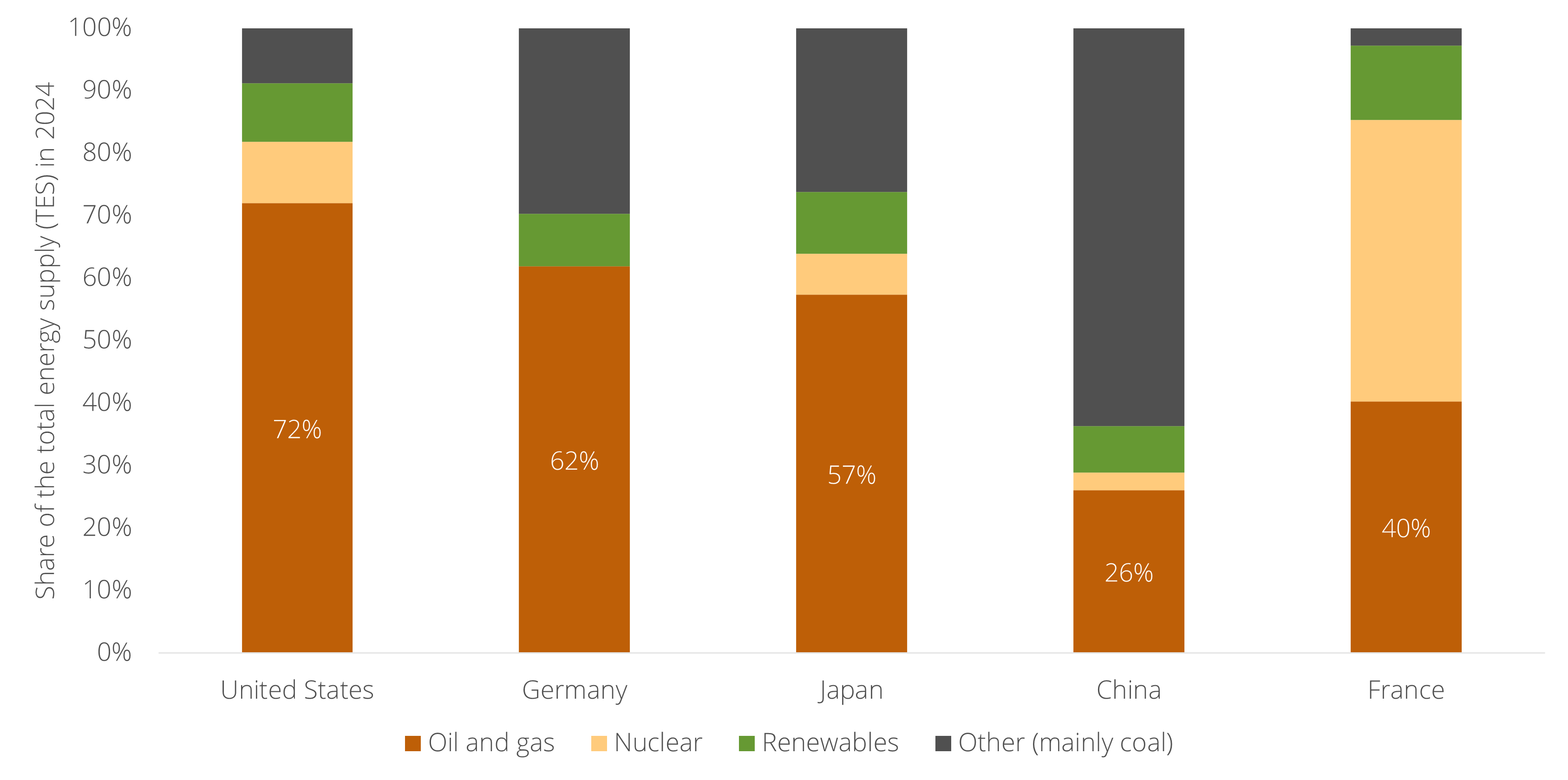
As the war in the Middle East continues to push up prices for oil and gas, two countries find themselves relatively well positioned – because they have been preparing for this scenario for decades: France and China. Both have pursued energy security through a mix centered on nuclear power and renewables, reducing their structural dependence on imported oil and gas.
For France, the vision dates to the 1973 oil crisis. Before it, France imported around 75% of its energy and had almost no domestic fossil fuel resources of its own. The response was the Messmer Plan of 1974 – a state-directed mobilization to build out nuclear capacity at a scale that remains unmatched in the Western world. Fifty years later, that bet is paying off.
In China, decades of industrial policy have been shaped by a refusal to become dependent on imported oil and gas – a vulnerability that Chinese planners call the "Malacca Dilemma": the risk that foreign powers could strangle Chinese energy supply by blocking maritime routes (like the Strait of Malacca, or currently, the Strait of Hormuz). Coal, despite its pollution, remains China's dominant energy source today, but explicitly as a bridge, not a destination. The destination is a mix of nuclear and renewables on a scale the world has never seen: more than half of all nuclear reactors currently under construction are in China, and China installs more solar capacity each year than the rest of the world combined.
The irony is that two very different political systems arrived at the same conclusion through the same logic: that the energy mix of nuclear and renewables is not merely relatively good for the environment, but offers energy security for the nation.